Collectif Phorie
In the field of visual and performing arts, it is not uncommon to encounter the adjective “poetic” to describe a work that seems to claim what Édouard Glissant called, in another context, “the right to opacity.” A work is considered poetic when it is difficult to understand, when it employs a seemingly indecipherable polysemy, when it completely turns its back on the communicative function of language.
This use of the term has always seemed reductive to me, as if poetry were a literary genre based on the refusal to say anything, when in fact it is the refusal to say little, as we do in everyday language. I resist using this word in criticism of the visual and performing arts precisely for this reason: I refuse to perpetuate a misunderstanding of poetry.
However, there are certain performances during the first few days of VIVA! that strike me as… well… poetic. In her opening remarks on the first evening, Michelle said that the performers work with images. Visual images, scenographic images, textual images, that is to say metaphors—there is indeed a correspondence here which, when approached from the perspective of affect theory, as the Phorie collective is attempting to do in the context of this residency, tells us, in my opinion, of the possibility of putting affects into circulation.
One image in particular, of Przemek Branas, comes to mind: holding one’s refuge at arm’s length. It speaks to the need for security, the weight of that need in the pursuit of one’s way of life, the possibility of turning it into a mask, a filter through which relationships with others can become increasingly distant. The image speaks to a normal impulse that can become devastating: protecting oneself.
And then, there is the linear sequence of images, here unfolding in time, there unfolding in the space of the page. After Alegría Gobeil’s performance, a spectator turns to us and asks if we perceived the performance’s progression as a list of tasks to be accomplished, almost a “to-do list.” I listen to her and think: a list of tasks like a list of verses that form a poem.
It is easy to defend a relationship with literature around the work of Alegría Gobeil, whose approach focuses on writing and reading. Yesterday, it seemed to me that images that resist a normative conception of happiness followed one another, as if to encourage us to linger longer in front of emotional objects such as a bottle of alcohol, or a mirror, or a steak (disgusting) in order to reflect on where they lead, to encourage us to do the work of drawing an intelligence from the emotional potential of these objects, which can lead to a new line, an avenue, a course of action.
And then, we must remember that the theory of affects, which is at the heart of this residency, has been extensively developed in the field of literary studies. In this sense, performance becomes poetic when we receive it as such. In The Promise of Happiness, Sarah Ahmed (re)defines happiness as a state of closeness to social norms and expectations. Therefore, judging oneself to be more or less happy amounts to positioning oneself in relation to a predefined path toward well-being that rhymes with family and the “good life.” And this path is performative because it brings us closer to objects that, as a result, become reputed to generate happiness. However, as she observes, if “to feel better is to be better” (p. 8), what about all those people who are not on this road?
For Ahmed, rejecting happiness becomes an emotional stance that not only short-circuits the myth of happiness, but also creates a collective awareness of the limits of happiness. It also engenders a necessary mourning, which Ahmed masterfully exemplifies with Mrs. Dalloway when she writes: ” It is hard labor just to recognize sadness and disappointment, when you are living a life that is meant to be happy but just isn’t, which is meant to be full, but feels empty. It is difficult to give up an idea of one’s life, when one has lived a life according to that idea. To recognize loss can mean to be willing to experience an intensification of the sadness that hopefulness postpones. To inherit feminism can mean to inherit sadness. There is sadness in becoming conscious not only of gender as the restriction of possibility, but also of how this restriction is not necessary.” (Sara Ahmed, A Promise of Happiness, Duke University Press, 2003, p. 75)
Gobeil’s performance becomes poetic when the sadness inherent in the realization that one is no longer waiting for happiness, a happiness that one does not desire anyway, takes hold. The “poetic” in the performance does not arise from the absence of transmission, but from the deployment of subjectivity and objects that circulate feelings and lead towards other affects that trigger other actions, a “drive,” a word that Eve Kosofsky Sedgwick uses precisely to define affect (Touching Feeling, Duke University Press, 2003, pp. 18-19).
In this sense, therefore, every performance is a poem, even if it sounds like a cliché, even if it may be a preconceived idea. In my opinion, however, this should not be seen as a refusal to share. There is no unidirectional message, no transitivity, but there are affects that are activated by the sequence of images. Performance should be seen as a series of openings that seek to break through our bodily, visual, and verbal languages, which are stiffened by personal habits and social norms, in order to activate something that could lead to a way of being in the world.
Collectif Phorie

« Habiter ce monde, c’est partir d’un lieu certes, un lieu-matrice,
mais dont on apprend à se déprendre pour l’articuler à d’autres lieux. »
(Felwine Sarr, Habiter le monde, Essai de politique relationnelle (2017), p. 42)
Last day,
Fadi’s Maqluba dinner buffet,
Culinary delights take center stage..
Intro,
Intensity,
Affect Bingo,
“My speech is your favorite part,” says Michelle,
Laughter,
FR version,
Alternate,
EN version.
…..
David Khang,
“My lord, my ladies, my dear colleagues”,
Epitoge,
Solemnity,
The comeback of the monarch butterfly.
Legislative documents,
High Authority,
Text archives.
Colonization.
Projected on screen,
Peace,
Friendship,
Respect.
….
——–Break———
Solitude Solitude and being silent in the crowd,
A profusion of voices,
Observing interactions,
Empty chairs and benches,
Holes,
Grasping fragments, not everything.
….
Claudia Edwards,
Footsteps,
Heaviness,
Figurines in the palms of the hands.
Relocation,
Tensions,
Strength and pain,
Crushing,
Dust in the air.
In the audience,
Someone lights a candle,
Every 90 seconds,
Another,
Flames and deaths.
Silence,
Free, Free Palestine.
….
Caroline St Laurent,
Arriving on tiptoes,
7 performance athletes,
Disco DIY heels,
Flexibility..
Push-ups,
40…50…70…,
100,
Effort,
Muscles.
Sports stadium atmosphere,
Weights/Boxing,
Cheers and encouragement,
“Oh boy,”
Exhaustion,
As reinforcement, close companionship.
Amphora,
Drawing balances the height of the poses,
Greek goddesses?
Anthropometry,
Blue body prints…
…
——Break——-
Feeling the end approaching,
Waiting,
Tangible,
Desires.
…
Ayana Evans,
Sonic chaos,
A scream,
Loss.
#Operationcatsuit,
Kitchen utensils clang against a metal bowl,
Who wants?
Objects thrown into the air.
Reclined on a disco table,
Looking towards the ceiling,
Eyes close,
Start the track It’s All Coming Back to Me Now by Celine Dion,
To touch,
Connections.
In harmony, all our bodies are (re)connected,
Slow motion and glances,
Tears and shivers.
Fiouuuuu, wowww.
Let’ s dance,
Start the track I Wanna Dance With Somebody by Whitney Houston,
Throwing balloons, boom bang,
Bouncing around,
Group dancing,
Joy.
….
Karaoke,
Electric energy,
Range of emotions,
Sleep,
Party.
Snippets of conversation,
“Come on, one last song, then I’m really leaving,”
Rehearsal and performance,
See you tonight?
See you tomorrow?
……
Thank you Michelle,
Thank you to all the artists,
Thank you to the entire festival team,
Thank you to my colleagues (Félix and Benoit) from collectif Phorie collective.
Thank you Vie-va.
Collectif Phorie
Affect Bingo
Objectives:
- Interpret performances through affect;
- Interpret emojis;
- Develop our emotional literacy;
- Identify an affective experience triggered by a work of art;
- Reflect on our position as spectators, and members of society.
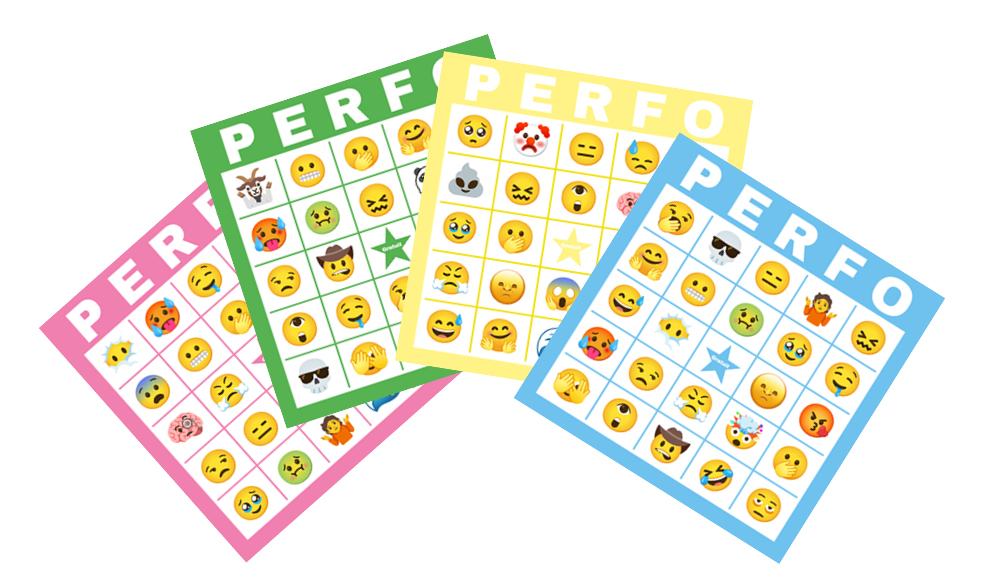
Rules of the game:
VERSION 1 : One-time event
- Collect a game card from the event organizers;
- Find a game partner and attend one or more performances together. Your partner may or may not (variant) be informed of their participation;
- Mark or cross out the emojis on your card that correspond to the emotions you experienced during the performance(s) in question. Emotions can be experienced firsthand, observed in the audience, or presumed in the artist;
- If the range of emotions experienced allows you to mark or cross out all the emojis in the same row, column, diagonal line, or (variant) all of the emojis in the card;
- Whisper “Bingo Perfo!” in your game partner’s ear;
- Recount your experiences with your game partner to validate your game card;
- Claim your prize at the bar or from the event organizers. Please note that you may be asked to provide further testimony.
VERSION 2 : Multiple events
- Find one or more game partners who attend performance events at approximately the same frequency as you. Agree on a start date for the game and a prize for the winner. There may be special prizes, such as one for the best testimonial (variant);
- Print or order, then distribute the necessary number of game cards based on the number of players. For a longer game, each partner can hold several game cards (variant);
- Preserve your card(s) like you would a loyalty card;
- For each emoji on your grid, identify a performance that elicited the corresponding emotions. Emotions can be experienced firsthand, observed in the audience, or presumed in the artist. Each performance can only be used once, and must be a firsthand experience from after the agreed-upon start date of the game;
- Obtain the artist’s signature to cross off the emoji, attesting to your experience. Write the name of the artist, the event, the date, and a memo about your experience on the back of your card;
- Check all the emojis in the same row, column, diagonal, or all of your emojis to win;
- Contact your game partners to report your victory;
- Recount your experiences with your game partners to validate your game card and claim your prize.
Game cards :
Cards currently available (4): blue, red, yellow, and green.
Download individual cards in jpg format (1500 X 1500 px, approx. 750 KB)
Download the print document in pdf format (US letter 8.5 X 11 in., 270 KB)
Download the InDesign kit for editing game cards in imdl and indd format (4.85 MB)
A web version will eventually be available.
Collectif Phorie
It must be starting since everyone gets quiet. The photographer’s lens finds him.
Kelvin Atmadibrata is sitting among the audience, unnoticed except for the upbeat music from the video game he is playing. Speaker sound quality in 2,000 square feet of crowded space.
Game over, he stands up gently and walks calmly to the front of the stage. The speeds contrast and blend together strangely. It is the same thread of time, but on two different temporalities: that of frenzied entertainment and that of serene presence. Time and tone are oxymoronic. This is only the beginning of a series of apparent contradictions that have a dual effect on the duration of the performance. The clue that our capacity to feel is not straightforward, never monopolized though always full in its multiplicity, here a quasi-grotesque ceremony:
the addiction of the game gives way to procession;
the grimace meets the chic of a clean white, a long train;
poppers dilate and elevate the pitiful umbrella or the sparkle of a vegetable daisy;
repeated applause continues, among the painfulness of effort, the crumpling of a paper rug;
while the video plays and prints the hand, the feet accumulate without end until the end of the traces, the end of the projection.
The action is a fold in which slowness gives way to solemnity, speeds rub together, and polarities overlap.
Collectif Phorie
Third day Viva-nt,
“Partial connections abound.
Getting hungry, eating, and partially digesting, partially assimilating, and partially transforming: these are the actions of companion species.” 1
Alex’s mother’s sautéed eggplant.
Immediacy of writing,
Body-space-time,
Festival fatigue,
Fusions of stimuli,
Ideas are popcorn brain.
Logbook,
At the bar,
Sparkling hibiscus drink,
Chaos of temporal emotions.
…
Alegría Gobeil,
Refuse the right track.
Meat and flesh,
Black latex gloves,
White shirt,
Black high-waisted pants.
Anti-psychiatric perspectives and Mad,
Blade,
Self-harm,
Bloodstains.
The smell of bleach,
The taste of gin,
Let’s drink.
….
Irma Optimist,
Middle fingers,
Black clothes,
Dark sticks,
Strikes and rhythm.
Cloud of coal,
Red flowers,
Circular repetition.
This moment: hungry children in the ruins,
Throwing flowers,
Names,
Genocide,
Memory.
….
Sakiko Yamaoka,
Change in the configuration of the space,
Friction of stone,
Chrkkrrrkrrkrkrkrrrrrrrr,
Trajectory,
Imbalance.
Slowness,
Startle,
Last stone,
The one near her home,
Opposite a rice field.
Selected images hung on two walls,
The sound of Sakiko’s voice,
Buddhism and Shintoism,
Spirituality.
…
Return,
End of the evening,
Go home.
Where?
1 Donna J. Haraway, Staying with the Trouble: Making Kin in the Chthulucene (2016), p. 65. Duke University Press.
Collectif Phorie
The Blood, the Soot, the Fall (part 1)
The raw, the cooked, it’s the binary system we can’t escape. Anyway, we like it rare. And when do we actually reach the right temperature? You have to test it with your middle finger until it’s almost burning, then shake your hand.
The ghostly red will later become flesh. For now, Alegrìa Gobeil adjusts the level to themself: vertically exceeding the standard height of a motionless audience, being on a par with others, and horizontally, following the lifeline from her palm. The power to act within a vanishing point.
Even the banal warning about the laser takes on a premonitory dimension in retrospect: “Close your eyes.” Nothing threatening, except for sensitive eyes. Except that it’s not about them, but rather about this new reference point, a line of desire.
They pull the psychiatric mirrors from under the bleachers, which hang securely on their hinges like so many points of anchor, but their vision is myopic, for the reflections are limited. And one of them is already uttering shrill cries of warning.
On these same mirrors, Gobeil’s tools are pieces of evidence: objects seized in a case, intended to be kept by the authorities to help in the search for the truth, and serve as evidence. They sit alongside a publication about guns, whose suicidal readership is, it seems, intolerable.
Only the hammer ultimately remains. After the fines have been handed out, the question remains unanswered: who will break this Lacanian stage (I recognize myself in this body that is not that of others) and its individualizing arbitration? Madmen, madwomen, in whose name do you speak?
Then, we plug in like this, amplify our voice, and avoid looking at the ceiling:
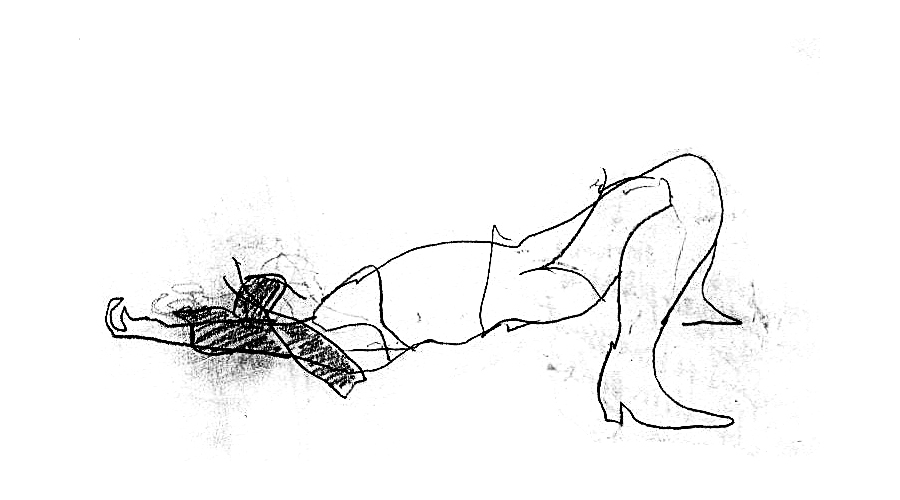
We delegate the preparation of the meal. We mark the spot where the steak will sit on our stomach. We go to lie down with the same energy and let the others have a drink. (It’s quite a few people.)
The stolen cup, adorned with blood from the thigh, traces a circle in the book without a title or an author. A quotation without a subject, analogous to our speech.
We talk about our problems, we talk with Brigitte Fontaine, friends, and therapists because “everything is about us, not just me.” We are all these people, we respond to those who prevent us from existing, who seek the origin of our multiplicity in diathesis, who must find tactics to continue to know what a body is capable of, even if it sometimes means suffering.
Follow the line, cut a few drops. And the bleach, that toxic purifier poured around the stage and left to be wiped up.
Collectif Phorie
Affects and performance,
Five-day writing residency,
A laboratory-like intention,
Phorie Collective.
Corporeal intensities,
Denounce expert status.
Anti-dictionary,
Keywords.
Affects,
Theory,
Body,
Performance,
Archives.
Writing affect,
Immediacy,
Temporalities,
In/formal discussions.
Witnesses,
Traces,
Vulnerabilities,
Surprise,
Intuition.
Collectif Phorie
An Inventory of Affects
On the occasion of their residency at VIVA! Art Action, Collectif Phorie is beginning an inventory: one that traces the forms and circulations of affect in performance art. We wish to investigate the many ways in which performance can radically alter an atmosphere, mobilize a range of intensities through the body, influence the audience’s emotions, and even engage desires and feelings within a collective register beyond the artist’s own biography. In short, we aim to write about the political dimension of what moves us in performance.
Our previous projects—focused on art criticism, reading practices, and diasporic experiences—have led us to question our own affective relationship to art. We draw in particular on the thought of Sara Ahmed, for whom emotions shape the boundaries between subjects, between individual and collective bodies. Far from reinforcing individuality, affect appears to us as a social play of relations that continually displaces the line between inside and outside, between self and world, between the I and the we.
The question guiding us at VIVA! will therefore be that of the economy of affect in performance. Actions, like words, images, or media, carry affective value and participate in the contemporary circulation of emotions. Performance, we believe, offers a particularly fertile ground for exploring these affective displacements. At times striking, surprising, or unsettling, performance acts upon bodies and spaces, transforming the very atmosphere in which it unfolds. How do emotions move between performers, audiences, and objects? How do they leave traces in memory and documentation? Through collective writing, we seek to give form to these circulations, to extend them, and to make their shared resonances perceptible.
In concrete terms, our process will take the shape of immediate post-performance discussions among members of the collective. These conversations will feed into the writing of short, freely structured texts, published in VIVA!’s daily bulletins. By putting our impressions in dialogue, we aim to move beyond anecdote and individual subjectivity to grasp what connects us within the shared, yet differentiated, experience of performance.
These conversations, at once felt and analytical, seek to reveal the affective knowledge of performance. We aim to engage with performance’s theoretical and poetic potential while constituting a living trace of it — a documentation of emotion as it takes shape through the act of sharing.